

New York’s Accident Compensation Rules Just Changed: Can You Still Recover If You’re More Than 50% at Fault?
On May 26, 2026, Governor Hochul signed New York’s new state budget, which includes one of the most significant reforms to motor vehicle accident compensation in decades. The new law changes the relationship between fault and pain-and-suffering damages, tightens the standard for a “serious injury,” and caps damages in certain high-risk situations. This article explains the core changes and how they affect people injured in car accidents, as well as everyday policyholders.
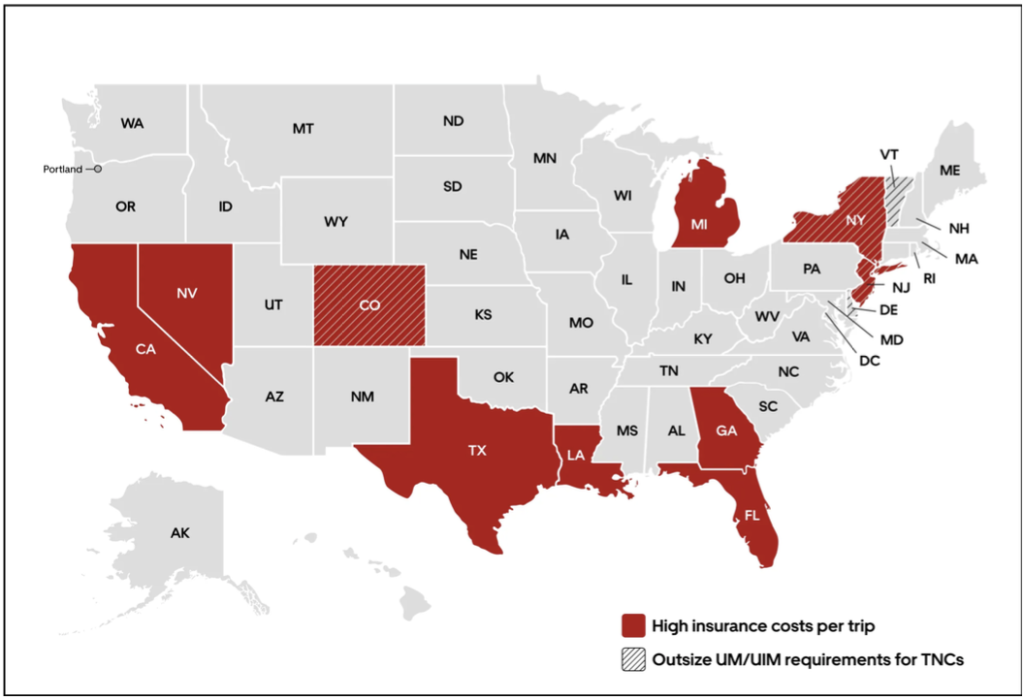
Map provided by Uber highlighting U.S. states it considers to have unfavorable insurance and claims requirements for rideshare trips; New York is shown among the states with high per-trip insurance costs. (Source: Uber)
Who Is Affected by This Reform?
This reform primarily affects:
- Drivers involved in motor vehicle accidents in New York State
- Vehicle passengers, including Uber, Lyft, and other rideshare passengers
- Pedestrians struck by a motor vehicle
- E-bike and certain e-scooter riders
- Anyone with a motor vehicle injury claim that is pending or being considered
The 51% Fault Bar: A Key Dividing Line for Non-Economic Damages
New York is moving away from its traditional pure comparative negligence rule. Under the old rule, damages could be apportioned at any percentage — even a driver only 10% at fault meant the injured party could still recover a proportional share, a scenario that came up often when both drivers blamed each other for running a light. Under the new rule, if a jury finds an injured person 51% or more at fault for the accident, they cannot recover non-economic damages (pain and suffering). It’s worth emphasizing: this bar applies only to non-economic damages — even if pain-and-suffering recovery is barred, an injured person may still recover basic economic losses through No-Fault insurance (more below).
Worked Examples: Can You Still Recover at Different Fault Levels?
I’m 40% at fault. Can I still recover?
Yes. Since your fault is below the 51% threshold, you can generally still recover non-economic damages (calculated based on the other party’s 60% share of fault), and you may also recover economic losses under No-Fault insurance.
I’m 60% at fault. Can I still recover?
Non-economic damages (pain and suffering) will generally be barred, since your fault meets or exceeds the 51% threshold. But you can typically still recover basic economic losses under No-Fault insurance (initial medical bills, limited lost-wage benefits, etc.).
I’m an Uber or Lyft passenger — am I affected?
Generally, minimally. Passengers usually aren’t found at fault for the accident itself, so the 51% bar typically doesn’t affect a passenger’s right to recover from the at-fault party.
I’m a delivery worker who was in an accident on an e-bike. Does the new law apply to me?
It may apply to the non-economic damages cap described below (see “Uninsured, Impaired, or Fleeing Drivers”). Whether it applies to your specific situation should be confirmed with an attorney.
Tighter Serious-Injury Standard: The 90/180-Day Rule Is Repealed
New York requires mandatory No-Fault insurance (excluding motorcycles) so that accident victims can get medical care quickly without waiting for a fault determination. No-Fault insurance covers only basic economic losses, capped at $50,000 total — including medical bills, up to $2,000 per month in lost-wage benefits, and up to $25 per day in transportation costs to medical treatment.
Previously, to recover damages beyond No-Fault insurance, an injured person had to meet New York’s “serious injury” standard, which included the 90/180-day rule: being unable to perform substantially all of your pre-accident daily activities (work, exercise, household tasks) for 90 of the 180 days following the accident. That provision has now been repealed. Going forward, a serious injury must be established through objective medical evidence — a fracture, permanent loss of a body function, or a significant and permanent limitation of use.
Uninsured, Impaired, or Fleeing Drivers: Non-Economic Damages Capped at $100,000
For an at-fault party who was uninsured, driving while impaired, or committing a crime or fleeing at the time of the accident, non-economic damages are capped at $100,000 regardless of their percentage of fault or the severity of the injury. Being “uninsured” can include operating vehicles such as e-bikes and e-scooters capable of a top speed of up to 25 mph. For example, if a delivery worker is riding an e-bike capable of reaching 25 mph, the maximum non-economic damages they could recover — regardless of fault or how serious the injury is — is $100,000. Worth noting: the 25 mph refers to the e-bike’s theoretical top speed, not its actual speed at the time of the accident.
New Rules for Auto Insurance Premiums
- Rate hikes require approval: Insurers can no longer raise premiums automatically as they could before (increases reached as high as 21% in 2024). Going forward, any rate increase requires approval from the New York State Department of Financial Services (DFS).
- Restrictions on ‘data-based pricing’: Insurers cannot charge different rates based solely on personal data like ZIP code or credit score, unless they can show the local accident or crime rate is genuinely and significantly higher — and even then, any resulting increase can’t exceed 25%.
- Proportional rebates for ‘excess profit’: When an insurer’s profit exceeds a 21% threshold, it must rebate part of the premium to consumers — a threshold few large insurers actually reach.
What’s Behind This Reform?
Supporters — including the insurance industry and some legislators — argue that New York’s previous pure comparative negligence rule and its relatively lenient “serious injury” standard were partly responsible for the state’s auto insurance premiums running persistently above the national average, along with high litigation volume, and that this reform is meant to reduce those systemic costs. Opponents — including plaintiffs’ attorneys and some consumer advocacy groups — argue the new rules significantly restrict recovery for parties found more at fault, and impose stricter damages caps on vulnerable groups injured while uninsured or riding e-bikes. The reform has already sparked widespread debate, and whether further judicial interpretation or amendment follows remains to be seen.
How Does This Affect Accidents That Already Happened or Cases Already in Progress?
The new rules apply to motor vehicle actions commenced on or after May 26, 2026 (the date the law took effect). This means:
- If your accident happened before May 26 but your lawsuit is filed after that date, the new rules will likely apply to your case.
- If you already filed suit before May 26 (your case is already pending), whether and how the new rules apply is not yet entirely clear and requires case-by-case analysis.
- Courts may provide further clarification on how the new rules apply to cases in this transitional period.
If you have questions about whether the new rules apply to your case, we recommend consulting an experienced attorney as soon as possible to confirm how the reform affects your specific situation.
Key Takeaways
These new rules, effective as of the law’s signing on May 26, 2026, apply to all motor vehicle actions commenced on or after that date (enacted through Assembly Bill A10008-C, Part EE of Chapter 58 of the Laws of 2026). Because the reform is so new, there is still considerable uncertainty about how courts will apply the new fault-first, injury-second procedure and the tightened serious-injury standard. How the new rules apply to a given case will vary — before drawing any conclusions about whether or how much you can recover, we recommend speaking with an experienced attorney.
Frequently Asked Questions
If I’m partly at fault, does the new 51% rule mean I get nothing?
Not necessarily. The bar applies only to non-economic damages (pain and suffering). Regardless of your fault percentage, you can generally still recover basic economic losses under No-Fault insurance; if your fault is below 51%, you can still recover non-economic damages proportionally (reduced by your share of fault).
What replaced the 90/180-day rule?
A serious injury must now be established through objective medical evidence — a fracture, permanent loss of a body function, or a significant and permanent limitation of use — rather than the prior temporary standard of being unable to perform daily activities for 90 of 180 days.
Does the $100,000 damages cap apply to e-bike accidents?
It may apply where the vehicle the rider used isn’t subject to New York’s mandatory insurance requirement (for example, an e-bike with a theoretical top speed of 25 mph). This is a new and untested area of law — confirm your specific situation with an attorney.
Can my insurer raise my premium just because of this reform?
No. Rate increases require approval from the New York State Department of Financial Services, and increases based on ZIP code or credit score are limited unless the insurer can show the local accident or crime rate is genuinely higher.
Does the new law mean my auto insurance premium will definitely go down?
Not necessarily. The DFS approval process only limits how much and how premiums can increase — it doesn’t guarantee they’ll decrease.
If I’m a passenger, does the new law affect me?
Generally very little. Passengers usually aren’t found at fault for the accident itself, so the 51% bar typically doesn’t bar a passenger from recovering non-economic damages from the at-fault party.
Does the new law apply to accidents that happened before it took effect?
What generally matters is when the lawsuit was filed, not when the accident happened — if the suit is filed after May 26, 2026, the new rules generally apply, even if the accident happened earlier. How the rules apply to cases already filed requires case-by-case analysis; see “How Does This Affect Cases Already in Progress” above.
Want to Know More About How the New Rules Affect Your Car Accident Claim?
New York car accident cases typically involve multiple legal issues — fault determination, No-Fault insurance, the serious injury standard, and statutes of limitations. Alpha Law’s Personal Injury team, led by Shengyang Wu, Esq., advises injured clients across New York in English and Chinese. Every case is different — contact us for a case evaluation tailored to your situation.